Expanding Your Business: What’s the Real Cost?
Expanding a business is one of the most exciting steps an owner can take, but it is also one of the riskiest. Many Australian business owners assume that direct expansion is the natural next move, but this approach often comes with significant costs and long-term financial commitments.
Franchising offers a different path. It allows you to grow your brand using the investment and energy of others, reducing your financial exposure and increasing scalability. Understanding the true cost difference between direct expansion and franchising helps you make smarter, more sustainable growth decisions.
What costs are involved in direct business expansion?
When you choose to expand directly, you carry full responsibility for funding and operating every new location. That means paying for premises, equipment, staff, marketing, insurance, and ongoing maintenance.
For example, a mobile service business expanding into a new area could face costs such as:
A vehicle, approximately $30,000
Tools and equipment, between $3,000 and $10,000
Staff salaries and training
Signage, uniforms, and marketing materials
These figures can quickly reach $95,000 to $100,000 per new mobile unit.
In a retail or hospitality setting, the investment climbs even higher:
Commercial lease, around $40,000 per year
Fit-out and signage, about $100,000
Initial stock, roughly $50,000
Staff costs, about $70,000
Marketing and grand opening promotions, approximately $15,000
That totals $275,000 to $300,000 just to get one new location up and running.
Beyond setup costs, you’ll also carry the ongoing obligations: rent, utilities, wages, insurances, and maintenance. Each new location compounds your financial and operational risk, which can limit how quickly or confidently you expand.
How does franchising shift financial risk and responsibility?
Franchising changes the entire equation. Instead of funding every site yourself, your franchisees invest in their own businesses. They take on the cost of setup, staffing, and local operations, while you provide the systems, brand, and ongoing support.
This structure delivers several clear advantages:
Reduced capital burden: You receive franchise fees upfront, turning what would have been a cost into a revenue stream.
Shared investment: Franchisees cover local expenses such as leases, wages, and marketing.
Improved cash flow: You preserve working capital and avoid overextending your resources.
Increased accountability: Franchisees are invested owners, not employees, so they are motivated to perform well.
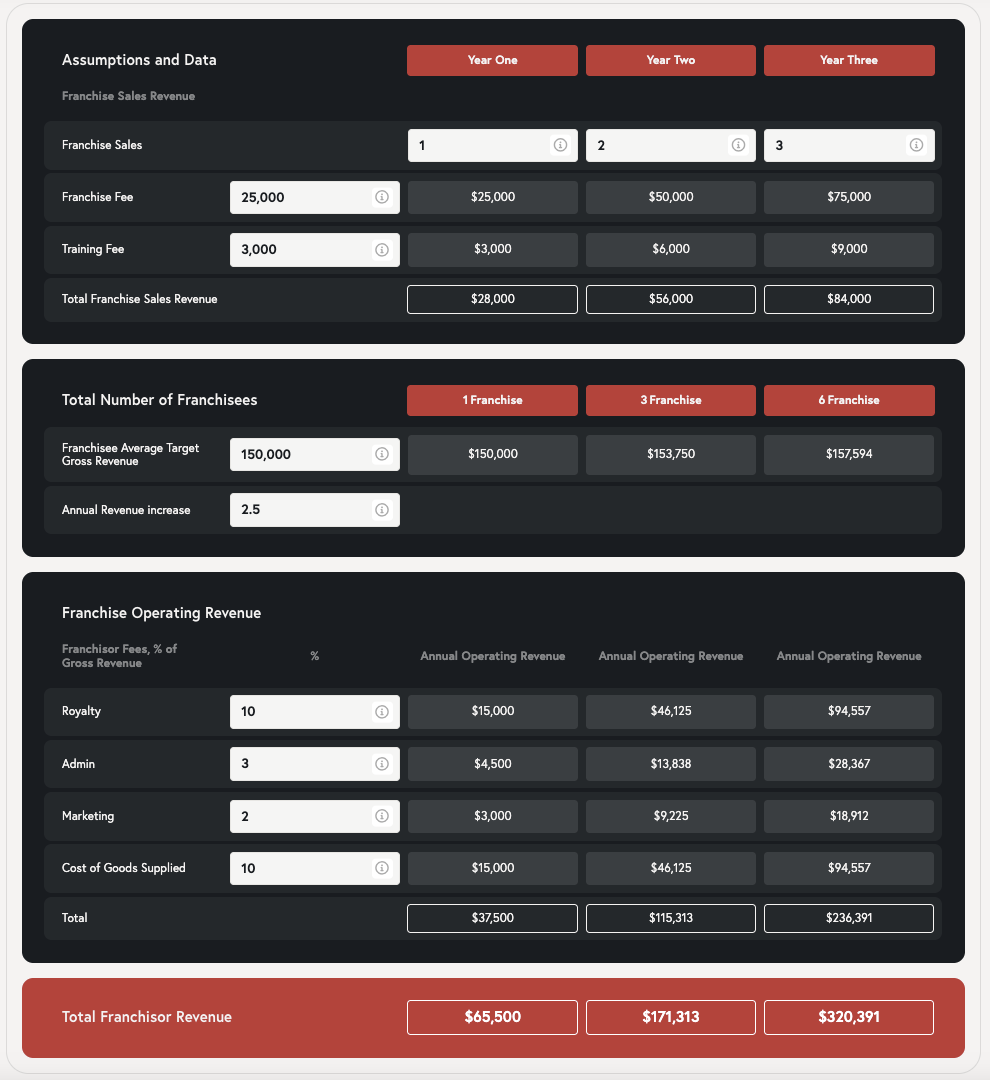
For instance, if a franchisee invests $280,000 in setting up their location and pays you a $40,000 franchise fee, that $40,000 represents additional income rather than an expense. This creates a faster, more sustainable path to expansion without placing your capital at risk.
Why does franchising allow faster growth with less stress?
Franchising is inherently designed for scalability. Because you are not responsible for managing every site’s daily operations, your time and resources can focus on strategic growth.
You can concentrate on system improvement, training, innovation, and marketing while franchisees handle the day-to-day management of their own businesses. This decentralised model not only increases efficiency but also fosters a network of highly motivated operators who have a personal stake in success.
When your franchisees thrive, your brand grows stronger. The combined effect is faster expansion, wider market coverage, and reduced stress compared to trying to manage multiple company-owned locations.
What are the pitfalls to consider when comparing costs?
While franchising often delivers lower risk and higher scalability, there are some important considerations to keep in mind when comparing models.
Franchise development costs: Building a franchise system requires upfront investment in legal documentation, manuals, and training materials.
Professional fees: Some consultants and legal advisors charge excessive fees, even for basic work. Choosing the right partner can save tens of thousands of dollars.
Model complexity: The structure of your franchise model, including leases, territories, and intellectual property, can affect setup costs.
System quality: Weak operational systems can lead to higher long-term costs in training, support, and problem resolution.
In short, franchising is not a shortcut. It’s a strategic investment in long-term scalability. Cutting corners early can lead to expensive fixes later.
How do the costs of franchising compare to direct ownership?
When comparing costs, the key difference lies in who pays for expansion. In a direct expansion model, you bear the cost of every location. In a franchise model, your franchisees cover those expenses while contributing to your revenue through franchise fees and ongoing royalties.
Here’s a simplified comparison:
Direct expansion:
Average setup cost per site: $280,000
Financial risk: fully on the business owner
Time commitment: high, due to managing staff and operations
Franchise model:
Setup cost per site: paid by franchisee
Income: upfront franchise fees and ongoing royalties
Financial risk: distributed across the network
Time commitment: focused on support, brand management, and growth
This difference allows business owners to scale faster, spread risk, and maintain healthy cash flow while empowering franchisees to grow their own investment.
How does franchising improve long-term sustainability?
Franchising isn’t just about lowering costs; it also strengthens your business foundation. By building a network of independent, invested operators, you create a self-sustaining model that encourages innovation and collaboration.
Franchisees bring local insights, community connections, and personal drive that help the brand perform better across markets. In turn, your focus shifts from managing individual sites to mentoring and supporting business owners, creating a more strategic and rewarding form of growth.
This collective structure allows you to maintain profitability while expanding into new areas, even during changing economic conditions.
How does TMPlus help business owners compare expansion options?
At TMPlus | Tereza Murray Franchising, we help Australian business owners evaluate the real cost of growth. Our team compares direct expansion and franchising using practical financial modelling, showing exactly how each approach impacts capital, risk, and scalability.
We provide complete franchise development packages, including structure design, documentation, financial models, and system support. Our goal is to make franchising an achievable, transparent, and cost-effective growth strategy for small and medium-sized businesses.
By understanding your options and their true costs, you can choose the expansion model that fits your long-term goals and resources with confidence.
Learn more at www.tmplus.com.au.
.svg)