
Franchising Isn't Reserved For Large Companies. Many Franchise Systems Begin With One Proven Small Business And An Owner Who Has Developed A Model That Can Be Replicated.
One of the most common misconceptions about franchising is that a business needs to be big before it can franchise.
Business owners often assume they need multiple locations, a large team, substantial turnover or national brand recognition before franchising becomes a realistic option.
They don't.
What matters considerably more is whether the underlying business is proven, commercially viable and capable of being replicated.
That distinction opens franchising to a much broader range of Australian businesses.
According to the Australian Bureau of Statistics, Australia had more than 2.81 million actively trading businesses at 30 June 2026. The overwhelming majority of Australian businesses are small. ABS data shows businesses employing fewer than 20 people account for around 97% of Australian businesses.
Within that enormous small-business economy are owners who have spent years developing successful business models without necessarily realising that what they have built could potentially be replicated through franchising.
One Successful Operation Can Be Enough To Start The Conversation
Having several company-owned locations can provide valuable evidence about how a business performs across different markets, managers and locations.
But there is no general requirement that a business must have a particular number of locations before considering franchising.
The Australian Government's guidance instead tells businesses considering franchising to assess whether their business model is suitable, develop a franchise plan, consider intellectual property, establish appropriate legal agreements and comply with the Franchising Code of Conduct.
For a small business owner, the starting point is therefore the quality of the existing operation.
Does the business have a trading history?
Does it generate sufficient revenue to support its costs?
Is there consistent demand?
Does the owner understand how customers are acquired?
Are the processes repeatable?
Is there something distinctive about the way the business operates?
If those foundations are present, franchising may be worth investigating.
A Franchise Is A Business System, Not Simply A Brand
A good logo, website and reputation can certainly contribute to a franchise opportunity.
But they aren't the franchise.
The real value is the system behind the brand.
Imagine an owner who has spent ten years building a successful property service business.
Over that time, they may have determined which marketing generates enquiries, how jobs should be quoted, which equipment works best, how customers should be communicated with, how staff should be trained and how jobs should be scheduled efficiently.
Someone starting independently would have to discover many of those things themselves.
A franchisee is entering a system where much of that groundwork has already been done.
The Australian Government describes a franchise as an arrangement in which a franchisee operates under an established business system, name or trademark and pays fees to the franchisor.
For an emerging franchisor, that operating knowledge is often one of the most valuable assets they have.
The Business Needs To Work Without The Founder Doing Everything
This is where some excellent small businesses discover they aren't quite ready to franchise.
The business may be successful because the founder personally holds everything together.
They generate the sales, know every customer, train every employee, solve every problem and make every important decision.
That can produce a very good business.
It doesn't yet produce a replicable one.
Before another person can operate the model, the founder's knowledge needs to become a system.
Processes need to be documented. Responsibilities need to be clear. Training needs to be developed. Quality standards need to be measurable.
The objective isn't to remove the founder from the business completely.
It is to ensure a franchisee doesn't need to be the founder to operate successfully.
You Don't Need A Large Head Office
Another misconception is that a business needs an established corporate head office before recruiting its first franchisee.
A new franchise network might initially have only a small support structure.
Technology has made that increasingly practical.
Customer relationship management platforms can track franchise enquiries. Learning management systems can deliver training. Cloud-based systems can provide access to operational documentation. Marketing can be managed centrally. Accounting, scheduling, customer management and reporting can increasingly be integrated digitally.
The Australian Government's 2024–2030 Small Business Statement specifically identifies digital capability as important to improving small-business productivity and resilience.
The important issue isn't how many people sit at head office.
It is whether the franchisor can deliver the support it has promised and increase that capacity appropriately as the network grows.
The Financial Model Needs To Work For Both Parties
A business being profitable for its founder does not automatically mean the franchise model will work financially.
Franchising introduces additional considerations.
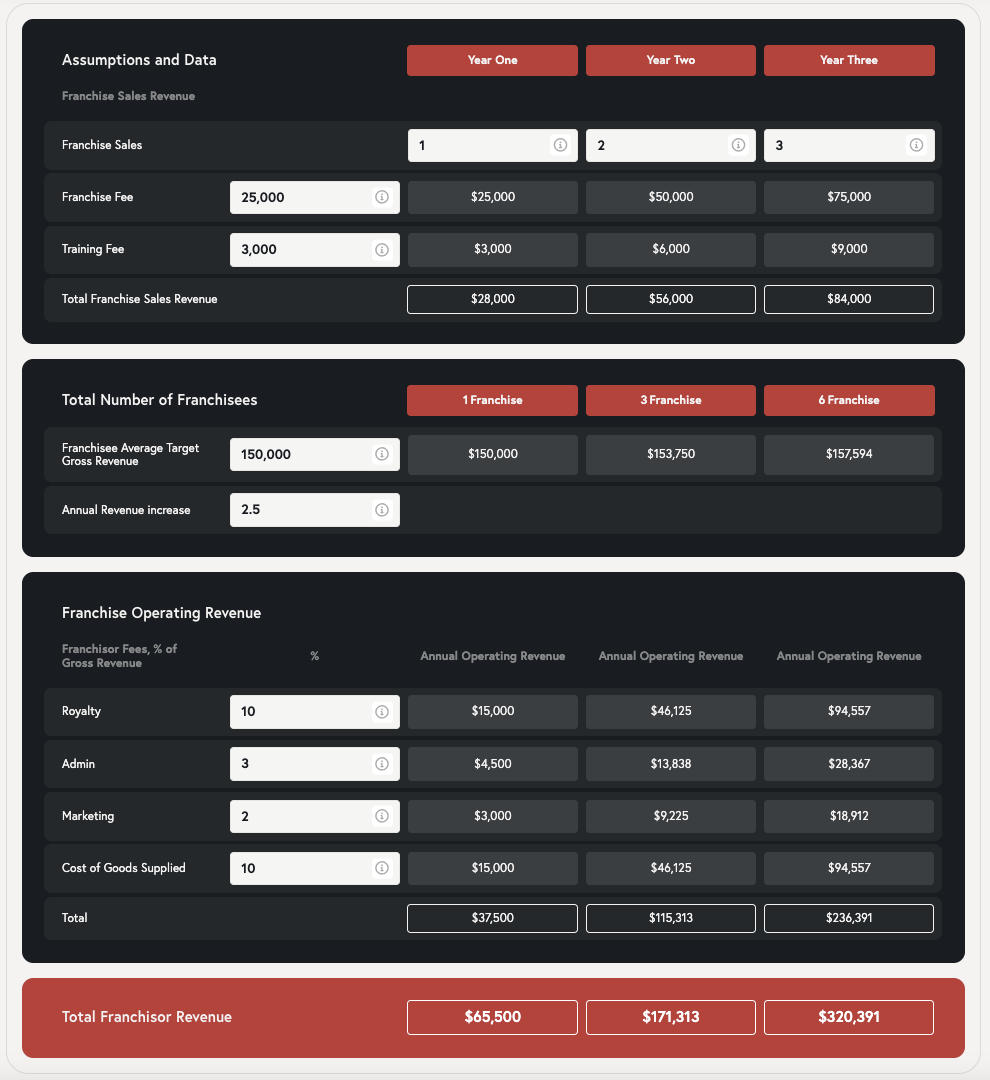
There may be an initial franchise fee, ongoing franchise fees, marketing contributions, technology costs and other expenses that don't exist in exactly the same form within the original operation.
These need to be considered when the franchise model is developed.
Australia's current Franchising Code also requires franchisors to give franchisees a reasonable opportunity to make a return on required investment during the term of the franchise agreement.
That makes financial modelling particularly important.
The franchisor needs a model capable of funding the infrastructure and support required to operate the network.
The franchisee needs a business proposition that makes commercial sense after the costs associated with belonging to that network are taken into account.
A franchise structure that only works financially for one side is unlikely to create a healthy network.
Small Can Actually Be An Advantage
Being an emerging franchise isn't necessarily something to hide.
The first franchise partners in a network may have direct access to the founder and become closely involved with a brand during an important stage of its growth.
The franchisor can also expand deliberately.
Instead of trying to sell dozens of territories immediately, a business may begin with one or two franchisees, learn from those initial locations and strengthen its systems before accelerating expansion.
That can be particularly valuable for a small business.
The first franchisee will inevitably expose questions that weren't obvious inside the founder's operation.
Training may need refinement. Procedures may need clarification. Technology may need adjustment.
Franchising can therefore be an iterative process.
The objective is not to pretend the network is already large.
It is to have strong enough foundations to support the franchisees being brought into it.
You Still Need To Be Ready For The Responsibilities Of Franchising
Franchising may reduce the need for the original owner to personally fund and manage every new territory, but it doesn't make expansion passive.
The role of the business owner changes.
Instead of simply operating their own business, they become responsible for supporting other business owners operating under the brand.
In Australia, that also brings substantial legal obligations under the Franchising Code of Conduct, including disclosure requirements, good-faith obligations, rules concerning franchise agreements and requirements around the Franchise Disclosure Register.
That is why franchising needs to be properly planned.
The opportunity can be substantial, but so is the responsibility.
So When Is A Small Business Big Enough To Franchise?
There isn't a magic turnover figure, number of employees or number of locations.
A more useful test is whether the business is sufficiently proven.
A business considering franchising should understand its financial performance, customer acquisition, operating procedures, competitive position and the support another operator would require.
It should also have enough trading experience to distinguish between what consistently works and what has simply worked temporarily.
From there, the business can assess territory potential, franchise fees, financial modelling, legal requirements, training, systems and recruitment strategy.
Sometimes that assessment shows the business is ready.
Sometimes it identifies work that should be completed first.
Both outcomes are valuable.
Franchising Is About Replicating What You Have Already Built
For a small Australian business owner, franchising shouldn't begin with trying to look like a large franchise company.
It should begin with understanding what made the original business successful.
What have you learned that another owner would benefit from?
What systems have you developed?
What mistakes have you already solved?
Why do customers choose your business?
Could those advantages be transferred to somebody operating in another territory?
If the answer to those questions is compelling, the size of the organisation today may be much less important than many owners assume.
Australia's franchise laws are detailed, and developing a franchise requires careful commercial and legal preparation. But franchising itself is not reserved for corporations.
A franchise network can begin with a successful small business, a proven model and the decision to turn the knowledge behind that business into a system somebody else can operate.
You don't need to already be a big business to franchise.
For the right business, franchising can be one of the ways you become one.
