

How Do Franchisors Make Money from Franchisees in Australia?
If you’re considering franchising your business, one of the first things you’ll want to understand is how franchisors actually generate income. The short answer is this, franchisors make money through a combination of upfront fees and ongoing payments, but the structure must be balanced so both the franchisor and franchisee benefit.
For small business owners across Australia, the focus should not be on maximising fees. Instead, it should be on building a sustainable model where franchisees can succeed, because their success is what ultimately drives long-term income for the franchisor.
Many new franchisors make the mistake of overthinking the financial model. In reality, the most effective franchise systems are built on simple, clear revenue structures that are easy to understand and practical to implement.
Why the Franchise Revenue Model Matters
Your franchise revenue model plays a critical role in how your business grows. It determines not only how you earn income, but also how attractive your opportunity is to potential franchisees.
A well-structured model creates alignment. Franchisees are motivated to grow their business, and as they do, the franchisor benefits through ongoing revenue. This creates a scalable system where growth is shared.
If the model is too expensive or overly complex, it can discourage potential franchisees and limit expansion. For small business owners in Australia, simplicity and fairness are often the key drivers of success.
How Do Franchisors Make Money from Franchisees?
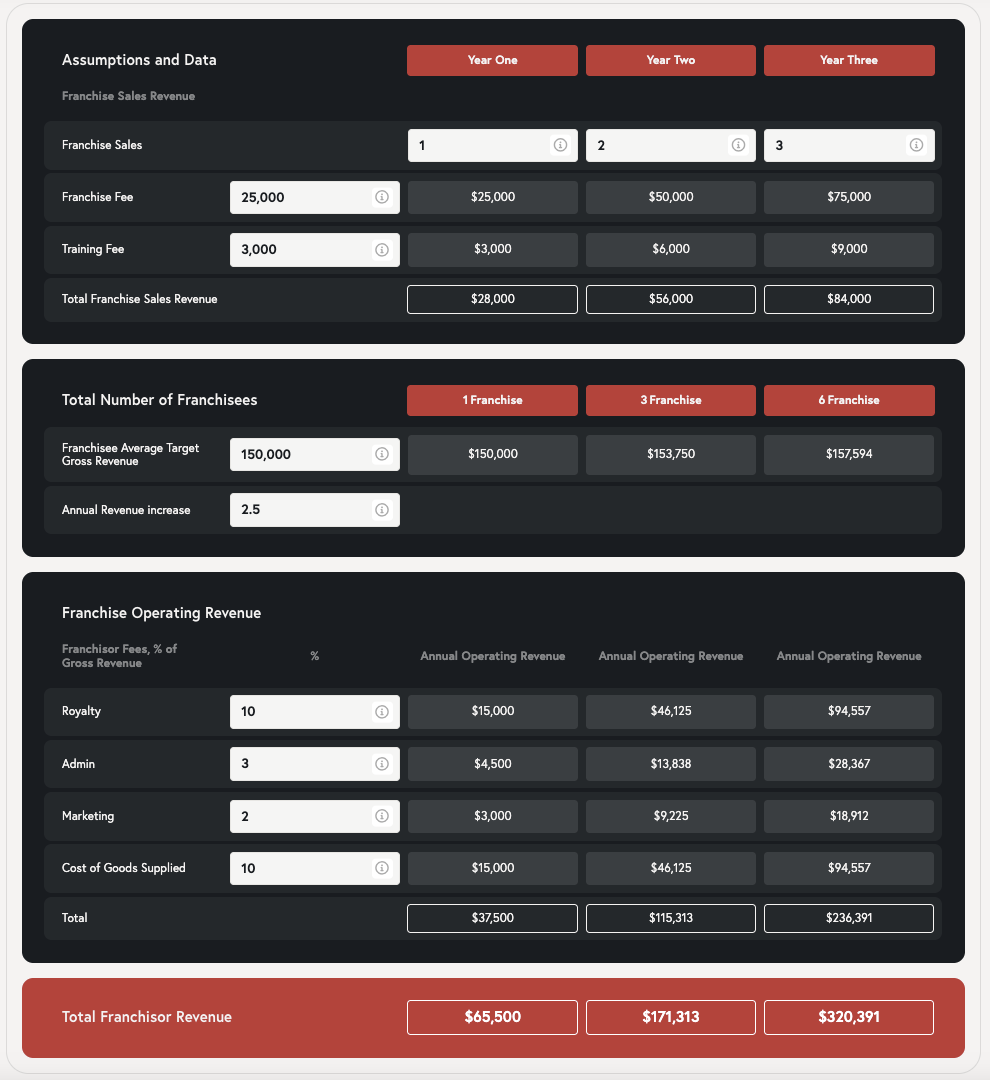
In simple terms, franchisors generate income through a combination of initial and ongoing payments.
These typically include:
- An upfront franchise fee
- Ongoing royalty payments
- Marketing or brand contributions
Not every franchise system uses all of these, and the structure can vary depending on the business. The key is ensuring that each revenue stream reflects genuine value and supports the overall growth of the network.
What is an upfront franchise fee?
An upfront franchise fee is a one-time payment made by a franchisee when they join your network.
The short answer is, it covers the cost of onboarding and setting up the franchise.
This usually includes:
- Initial training and guidance
- Access to your brand and systems
- Support during the setup phase
For small business owners in Australia, this fee should be realistic and tied to the actual work involved in getting a franchisee established. If it is set too high, it can create a barrier to entry and limit your ability to attract quality candidates.
A well-balanced upfront fee helps recover setup costs while keeping the opportunity accessible.
How do franchise royalties work?
Franchise royalties are ongoing payments made by franchisees, typically calculated as a percentage of revenue.
In simple terms, they provide the franchisor with a consistent income stream as the network grows.
These payments support:
- Ongoing business support
- System improvements
- Training and development
- Brand growth
For many franchise systems, royalties are the primary long-term income source. The key is setting them at a level that allows franchisees to remain profitable while contributing to the strength of the brand.
If royalties are too high, franchisees may struggle. If they are too low, the franchisor may not have the resources to support growth.
Do franchisors earn money from marketing contributions?
Some franchise systems include marketing contributions, often referred to as a brand fund.
The short answer is, these are designed to support collective marketing efforts rather than generate profit.
These contributions may be used for:
- Digital marketing campaigns
- Brand awareness initiatives
- Lead generation
- National or regional promotions
For smaller franchise systems in Australia, this is not always necessary in the early stages. Many businesses begin with simple, local marketing strategies and introduce broader campaigns as the network grows.
The key is ensuring that any marketing contribution delivers clear value back to franchisees.
Are there other ways franchisors make money?
Yes, there are additional ways franchisors can generate income, but these should always align with supporting franchisees.
These may include:
- Supplying products or materials
- Negotiating preferred supplier arrangements
- Offering optional support services
When structured correctly, these income streams can create efficiencies across the network. However, they should never feel like unnecessary costs to franchisees.
For small business owners, the focus should always remain on value and simplicity.
How much should a franchisor charge?
There is no fixed formula for franchise fees, as it depends on your industry, business model, and the level of support you provide.
Your fee structure should:
- Be commercially viable for you
- Allow franchisees to earn a reasonable income
- Reflect the value of your brand and systems
For many Australian small businesses, keeping fees realistic is what drives growth. A model that is accessible and fair will attract better franchise partners and scale more effectively.
What is the biggest mistake in franchise revenue models?
The most common mistake is focusing too heavily on short-term income.
Some business owners set high upfront fees or royalties without fully considering how this impacts franchisee profitability. This can make the opportunity less attractive and harder to grow.
The most successful franchise systems take a long-term approach. They prioritise franchisee success, knowing that a profitable network creates ongoing revenue and sustainable expansion.
How do you build a sustainable franchise revenue model?
A sustainable franchise model is built on balance, clarity, and alignment.
It should:
- Be simple and easy to understand
- Provide clear value to franchisees
- Support long-term growth rather than quick wins
For small business owners, this often means starting with a straightforward structure and refining it over time.
Your model should evolve as your network grows, allowing you to improve systems, support, and overall performance.
Final Thoughts
Franchisors make money through upfront fees, ongoing royalties, and in some cases, additional revenue streams. However, the real driver of success is not how much you charge, but how well your model supports franchisee profitability.
If your franchisees are successful and your systems deliver value, your income will grow naturally as your network expands.
TMPlus | Tereza Murray Franchising works with small business owners across Australia to develop sustainable franchise models, including fee structures that balance profitability, growth, and long-term success. Learn more at www.tmplus.com.au
.svg)